
The beauty industry has become more competitive than ever. New cosmetic and skincare brands enter the market every year, giving consumers more choices than they have ever had before. At the same time, the way people buy beauty products has changed significantly. Instead of making decisions based solely on advertisements or in-store recommendations, most customers now spend time researching products online, reading reviews, watching videos, and comparing alternatives before making a purchase.
As a result, having a strong digital presence is no longer optional for beauty brands. However, success does not come from running a few ads or partnering with influencers alone. Sustainable growth requires a well-structured Cosmetics Marketing Strategy that connects branding, content, SEO, social media, advertising, and customer experience into a unified plan. In this guide, we will explore the key steps involved in building an effective marketing strategy that helps cosmetic brands attract customers, increase sales, and build long-term loyalty.
What Is the Best Marketing Strategy for Cosmetic Brands?
The best marketing strategy for cosmetic brands combines audience research, strong brand positioning, SEO, content marketing, social media marketing, paid advertising, and conversion optimization. Rather than relying on a single channel, successful beauty brands create an integrated system that attracts potential customers, builds trust, drives purchases, and encourages repeat business. This balanced approach creates sustainable growth and long-term competitive advantages.
What Is a Cosmetics Marketing Strategy?
A Cosmetics Marketing Strategy is a long-term plan that helps beauty brands attract potential customers, build trust, increase sales, and encourage repeat purchases. It provides a framework for selecting the right marketing channels, creating relevant content, allocating budgets, and measuring results.
While many businesses use the terms strategy and tactics interchangeably, they serve different purposes. A strategy defines the overall direction and goals, while tactics are the specific actions used to achieve them. For example, improving organic visibility may be a strategic goal, while SEO, content creation, and link building are tactics that support it.
In the highly competitive beauty industry, a clear marketing strategy helps brands stay consistent, connect with the right audience, and focus on sustainable growth rather than short-term sales gains.
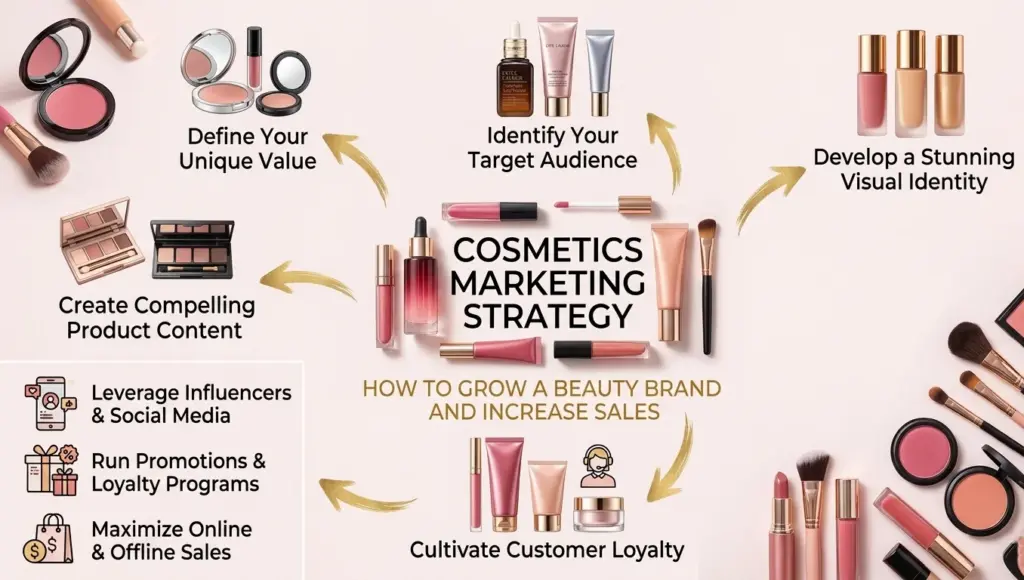
How to Create a Marketing Plan for Cosmetics Brands
Creating a marketing plan for a beauty business does not have to be complicated. The most successful brands typically follow a structured process that aligns their business goals, target audience, marketing channels, and performance metrics. A well-developed Cosmetics Marketing Strategy acts as the foundation for this plan and helps ensure that every marketing activity supports long-term growth.
Set Business and Marketing Goals
The first step is defining clear and measurable goals. These objectives might include increasing online sales, growing brand awareness, improving customer retention, launching a new product line, or expanding into a new market. Establishing specific targets makes it easier to prioritize activities and evaluate results later.
Research the Market and Competitors
Before investing in campaigns, brands should understand the competitive landscape. Analyze competitor products, pricing strategies, messaging, customer reviews, and marketing activities. This research helps identify opportunities, market gaps, and areas where your brand can stand out.
Define Your Target Audience
A successful beauty marketing strategy is built around a clear understanding of the customer. Identify who your ideal buyers are, what challenges they face, what influences their purchasing decisions, and which channels they use most often. The more specific the audience definition, the more effective your marketing efforts will be.
Choose the Right Marketing Channels
Not every channel will be equally valuable for every beauty brand. Some businesses may generate strong results through social media and influencer partnerships, while others may benefit more from SEO, email marketing, or paid advertising. The goal is to focus resources on the channels most likely to reach and convert your target audience.
Create a Content and Campaign Calendar
Consistency is critical in cosmetic brand marketing. Developing a content and campaign calendar helps ensure that product launches, educational content, seasonal promotions, and brand campaigns are planned in advance. This approach improves coordination across marketing channels and creates a more consistent customer experience.
Allocate Budget and Resources
Every marketing plan should include a realistic budget. Determine how much will be invested in content creation, SEO, advertising, influencer partnerships, software tools, and other activities. Allocating resources strategically helps maximize return on investment and prevents overspending on low-performing channels.
Track Performance and Optimize
A marketing plan should never remain static. Regularly review performance data, including traffic, conversions, customer acquisition costs, retention rates, and revenue. These insights allow brands to identify what is working, eliminate ineffective tactics, and continuously improve their marketing strategy for cosmetic products over time.
By following these steps, beauty brands can build a practical roadmap that turns marketing goals into measurable business results while creating a stronger and more sustainable Cosmetics Marketing Strategy.
Analyze the Competitive Beauty Market
Before investing in advertising, content creation, or influencer partnerships, beauty brands need to understand the market they are entering. A strong marketing strategy for cosmetic products starts with research. Analyzing competitors and market trends helps businesses identify opportunities, avoid costly mistakes, and discover gaps that competitors have overlooked.
This process provides valuable insights into customer expectations, pricing standards, content performance, and acquisition channels. Instead of making decisions based on assumptions, brands can build their strategy using real market data.
Identify Direct and Indirect Competitors
The first step is identifying both direct and indirect competitors.
Direct competitors offer similar products to the same audience. For example, a vegan skincare brand may compete directly with other vegan skincare companies targeting environmentally conscious consumers.
Indirect competitors solve similar customer problems through different products or positioning. A luxury skincare brand may indirectly compete with dermatology clinics, beauty subscription services, or wellness brands that target the same customer segment.
Once competitors are identified, analyze their product offerings, pricing structure, packaging, customer reviews, promotions, and brand messaging. Understanding how competitors position themselves in the market helps reveal areas where your brand can differentiate itself.
For example, while The Ordinary built its reputation around ingredient transparency and science-backed formulations, Glossier gained traction by focusing on community-driven branding and minimalist beauty routines. Both operate within the beauty sector, yet their positioning strategies appeal to different audiences.
Evaluate Competitor Marketing Channels
The next step is understanding how competitors attract and engage customers.
Start by examining their social media presence. Look at the platforms they prioritize, the type of content they publish, posting frequency, engagement levels, and audience interactions.
Paid advertising is another valuable area of analysis. Brands can often identify recurring promotional themes, product launches, seasonal campaigns, and retargeting efforts through competitor ads.
SEO performance also provides important insights. Reviewing the keywords competitors rank for, the content they publish, and the pages generating organic traffic can reveal significant opportunities.
Email marketing should not be overlooked either. By subscribing to competitor newsletters, brands can study welcome sequences, promotional campaigns, product launches, and customer retention initiatives.
The goal is not to copy competitors but to understand what is working within the market and identify opportunities to create a stronger marketing strategy for skincare products and beauty brands.
Discover Content and Keyword Opportunities
Content and keyword research often uncover some of the most valuable growth opportunities available to beauty businesses.
Many competitors focus heavily on product promotion while neglecting educational content. This creates opportunities to publish guides, tutorials, comparisons, and problem-solving articles that attract potential customers earlier in the buying journey.
Keyword analysis can reveal topics with strong search demand and relatively low competition. Questions related to skincare routines, ingredient comparisons, product benefits, and treatment recommendations often provide excellent opportunities for organic growth.
For example, a skincare company may discover that competitors rank for transactional keywords but have limited content around educational searches. By creating detailed resources that answer these questions, the brand can attract qualified traffic and establish authority before customers reach the purchasing stage.
This approach strengthens both organic visibility and cosmetic brand marketing efforts by connecting the brand with consumers throughout multiple stages of the customer journey.
Know Your Beauty Brand and Target Audience
Every effective Cosmetics Marketing Strategy starts with a deep understanding of the brand itself and the audience it serves. Without clarity on positioning and customer needs, even the strongest campaigns tend to feel inconsistent or fail to convert. Beauty consumers are highly influenced by perception, trust, and emotional connection, which makes brand identity and audience insight essential for long-term success.
Define Your Brand Positioning
Brand positioning defines how your cosmetic or skincare brand is perceived in the minds of consumers compared to competitors. It answers a simple but critical question: why should someone choose your brand over another?
In the beauty industry, positioning often falls into specific categories such as luxury, organic, vegan, affordable, or professional skincare. Each position attracts a different type of customer and requires a distinct tone of communication, pricing strategy, and visual identity.
For example, luxury beauty brands focus on exclusivity, premium packaging, and aspirational messaging. In contrast, affordable brands emphasize accessibility and everyday usability. Meanwhile, clean or organic brands highlight safety, natural ingredients, and transparency.
Clear positioning helps avoid confusion in messaging and ensures that every part of the marketing strategy for cosmetic products feels aligned. Without it, brands risk trying to appeal to everyone and ultimately failing to connect with anyone in a meaningful way.
Identify Your Unique Value Proposition (UVP)
The Unique Value Proposition (UVP) is what makes a beauty brand genuinely different in a crowded market. It defines the specific benefit or promise that competitors do not offer in the same way.
In cosmetics and skincare, UVPs are often built around factors such as cruelty-free formulations, clean beauty standards, dermatologist-tested products, premium ingredients, or sustainable packaging. These elements help create trust and emotional appeal, especially in a market where customers are highly aware of product quality and ethical considerations.
A strong UVP should be simple, clear, and consistently reflected across all marketing channels. For instance, The Ordinary built its UVP around transparency and science-backed formulations, which allowed it to stand out in an industry often criticized for inflated claims and unclear ingredient lists. Similarly, Glossier positioned itself around real beauty and minimal routines, turning simplicity into a powerful competitive advantage.
Create Detailed Customer Personas
Customer personas represent semi-fictional profiles of ideal buyers based on real data, behavior patterns, and demographic insights. They help beauty brands understand who they are speaking to and how to communicate effectively.
A well-developed persona includes factors such as age, gender, lifestyle, skincare concerns, purchasing behavior, and preferred communication channels. For example, one segment might consist of young consumers interested in trend-driven makeup products discovered through social media, while another may include older customers focused on anti-aging skincare solutions with proven clinical results.
Understanding these differences is essential when building a beauty marketing strategy because it directly influences everything from content creation to advertising platforms. A brand targeting Gen Z customers may prioritize TikTok and influencer collaborations, while a professional skincare brand may rely more on educational content and search-based discovery.
When personas are clearly defined, every part of the Cosmetics Marketing Strategy becomes more focused, more relevant, and significantly more effective in converting interest into long-term customer relationships.
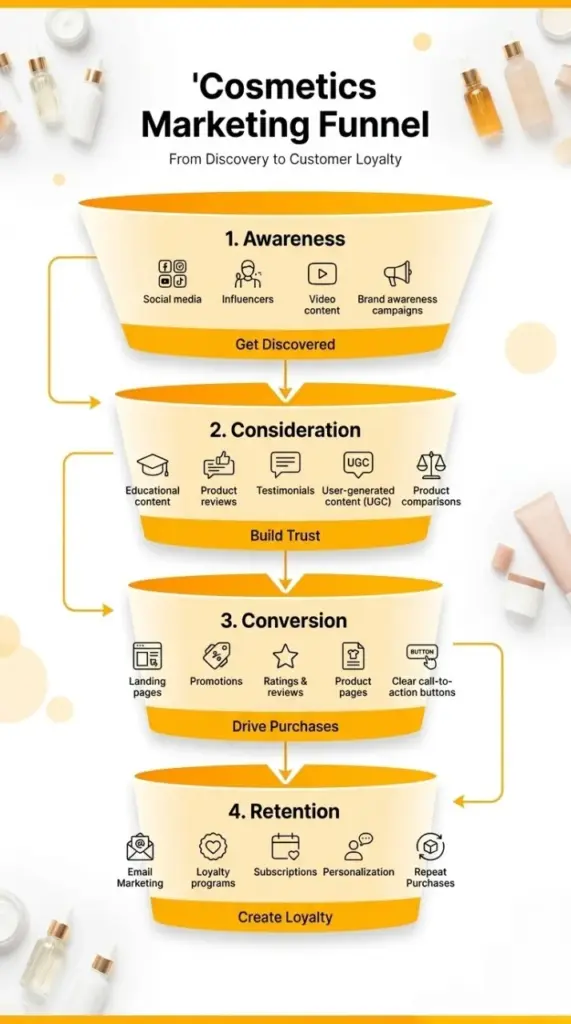
Build a Marketing Funnel for Your Cosmetics Brand
A marketing funnel represents the journey a customer takes from first discovering a brand to becoming a loyal buyer. In the beauty industry, this journey is rarely linear. Customers often interact with multiple touchpoints before making a decision, which makes funnel design a critical part of any Cosmetics Marketing Strategy.
Awareness: Getting Discovered
At the awareness stage, the goal is to introduce the brand to potential customers who may not yet know it exists. Social media platforms play a major role here, especially visually driven channels like Instagram, TikTok, and YouTube.
Influencer collaborations are also highly effective in the beauty space because they allow brands to reach established audiences with built-in trust. Video content, such as tutorials, product demonstrations, and before-and-after results, helps capture attention and create initial interest. Brand awareness campaigns further support visibility by expanding reach through paid media.
A strong example of this approach can be seen in Glossier, which initially grew by leveraging social media storytelling and community-driven content rather than traditional advertising.
Consideration: Building Trust
Once customers become aware of a brand, they begin evaluating whether it is trustworthy and worth purchasing from. This stage is focused on education, validation, and social proof.
Educational content plays a key role by explaining product benefits, ingredients, and usage routines. Product reviews and testimonials help reduce hesitation by providing real-world experiences from other users. User-generated content (UGC) is particularly powerful in the beauty industry because it feels authentic and relatable.
Product comparisons also help customers make informed decisions, especially in skincare, where ingredient differences can significantly impact results. Brands that invest in transparent and helpful content at this stage tend to see higher engagement and stronger purchase intent.
Conversion: Turning Visitors into Customers
The conversion stage focuses on turning interested users into paying customers. At this point, the user already understands the product and is evaluating the final decision.
Optimized landing pages are essential because they guide users toward purchase with clear messaging and structured information. Offers and promotions can help reduce friction, especially for first-time buyers. Social proof, such as ratings and reviews, reinforces trust at the final stage.
Product page optimization is also critical. High-quality images, clear descriptions, ingredient transparency, and structured data all contribute to better conversion rates. Strong calls-to-action ensure users know exactly what step to take next.
Retention: Driving Repeat Purchases
Retention is often overlooked but is one of the most profitable parts of any Cosmetics Marketing Strategy. Keeping existing customers is significantly more cost-effective than acquiring new ones.
Email marketing is widely used to maintain communication, promote new products, and offer personalized recommendations. Loyalty programs encourage repeat purchases by rewarding customer engagement over time. Subscription models can also be effective, especially for skincare products that require regular use.
Personalized campaigns based on customer behavior and purchase history help strengthen relationships and increase lifetime value. Brands that invest in retention strategies often build stronger long-term revenue stability and customer loyalty.
The Most Effective Marketing Channels for Cosmetic Brands
Marketing channels are the platforms and methods used to support each stage of the customer journey. For beauty and skincare businesses, choosing the right channels is critical because each platform attracts different audiences, behaviors, and levels of purchase intent. A strong Cosmetics Marketing Strategy does not rely on a single channel but instead combines multiple touchpoints to maximize reach and engagement.
Social Media Marketing
Social media plays a central role in modern beauty marketing strategy. Platforms like Instagram, TikTok, and YouTube are highly visual, making them ideal for showcasing cosmetic products, tutorials, and transformations.
Beauty brands use these platforms to build awareness, educate audiences, and create emotional connections. Short-form videos, reels, and before-and-after content are particularly effective in capturing attention quickly. Social media also allows brands to build communities where users share experiences, feedback, and routines.

Influencer Marketing
Influencer marketing has become one of the most influential tools in the beauty industry marketing ecosystem. Consumers tend to trust real people more than traditional advertisements, especially when it comes to skincare and cosmetics.
Micro and macro influencers help brands reach targeted audiences and build credibility. For example, many emerging skincare brands have grown rapidly by collaborating with influencers who demonstrate product usage and share honest reviews. Sephora has also effectively used influencer partnerships to amplify product launches and seasonal campaigns.
Content Marketing
Content marketing focuses on educating and informing potential customers rather than directly selling to them. This includes blog articles, skincare guides, video tutorials, ingredient breakdowns, and expert advice.
In the cosmetics marketing strategy landscape, content marketing is essential for building trust and authority. Brands that invest in educational content often attract users earlier in the buying journey, especially those searching for solutions to specific skin concerns or product comparisons.
Email Marketing
Email marketing remains one of the most powerful tools for customer retention and repeat purchases. It allows beauty brands to communicate directly with their audience without relying on algorithms or paid reach.
Brands use email campaigns for product launches, personalized recommendations, abandoned cart reminders, and loyalty rewards. A well-structured skincare marketing strategy often includes automated email flows that guide customers through their lifecycle and encourage long-term engagement.
Paid Advertising
Paid advertising helps beauty brands scale visibility and reach highly targeted audiences quickly. Platforms like Google Ads and Meta Ads allow precise targeting based on demographics, interests, and behavior.
Retargeting campaigns are especially effective in the cosmetics industry because customers often need multiple interactions before making a purchase. Ads reminding users of viewed products or offering limited-time discounts can significantly improve conversion rates.
However, paid ads work best when combined with strong branding, optimized landing pages, and supporting content. Without a solid foundation, even high-budget campaigns may fail to generate sustainable results.
How SEO Can Help Cosmetic Brands Generate Consistent Sales
Search engine optimization is one of the most reliable long-term growth drivers in any Cosmetics Marketing Strategy. Unlike paid campaigns that stop generating traffic once the budget ends, SEO builds a sustainable flow of qualified visitors who are actively searching for beauty solutions, skincare routines, and product recommendations.
In the beauty industry marketing landscape, SEO is especially powerful because customers rely heavily on search before making a purchase. They compare products, read reviews, and look for educational content before deciding. This makes organic visibility a key factor in driving consistent sales over time.

Optimize Product Pages
Product pages are often the final step before conversion, so their optimization directly impacts revenue. Strong product pages should include clear and keyword-aligned titles, detailed descriptions, high-quality images, and structured data to help search engines understand the content.
In a well-executed marketing strategy for cosmetic products, product pages are not just sales tools but also SEO assets. For example, adding ingredient explanations, usage instructions, and benefit-focused descriptions can help capture long-tail search traffic while improving conversion rates.
Brands like The Ordinary are well-known for their highly detailed and transparent product pages, which not only improve trust but also help them rank for a wide range of search queries.
Create Educational Beauty Content
Educational content is one of the most effective ways to attract organic traffic in the cosmetics marketing strategy ecosystem. Instead of only promoting products, brands can create content that solves real customer problems.
This includes skincare routines, ingredient guides, product comparisons, and problem-solving articles. For example, explaining how to choose the right moisturizer for dry skin or comparing vitamin C serums can attract users at the research stage.
This approach helps brands appear earlier in the customer journey and build authority before purchase decisions are made. Over time, this strengthens both visibility and trust.
Target High-Intent Search Queries
High-intent search queries are keywords that indicate a user is close to making a purchase decision. These often include terms like “best,” “buy,” “review,” or “compare.”
In a skincare marketing strategy, targeting these keywords is essential for driving conversions. For example, searches like “best anti-aging serum for sensitive skin” or “top vitamin C serum for glow” signal strong purchase intent.
By optimizing content around these queries, beauty brands can attract users who are not just browsing but actively looking to buy, making SEO a direct revenue driver rather than just an awareness tool.
Build Topical Authority in Beauty and Skincare
Topical authority refers to how well a website is recognized as an expert in a specific subject area. In cosmetics brand marketing, this means covering beauty topics comprehensively and consistently.
Brands can build topical authority through content clusters, where related articles are grouped around central themes like skincare routines, acne treatment, or anti-aging solutions. Internal linking between these pages helps search engines understand the relationship between topics and improves overall rankings.
Over time, this strategy signals to search engines that the brand is a trusted source in the beauty space, which increases visibility across multiple keywords.
Improve Local Visibility for Beauty Businesses
Local SEO is important for cosmetic brands that operate physical stores, salons, or clinics. It helps businesses appear in location-based searches such as “beauty clinic near me” or “skincare store in London.”
Optimizing a Google Business Profile, collecting customer reviews, and ensuring consistent business information across platforms can significantly improve local rankings.
For example, many customers searching for in-person skincare treatments rely on local results to make decisions quickly. Strong local visibility can therefore directly increase foot traffic and in-store sales, making it an essential part of any beauty product marketing strategy.
Beauty Marketing Trends Brands Should Watch
The beauty industry is evolving quickly, and brands that want to stay competitive need to continuously adapt their Cosmetics Marketing Strategy to emerging trends. Consumer expectations are shifting toward personalization, transparency, and social-driven shopping experiences. Understanding these changes helps brands stay relevant and maintain long-term growth.
Micro-Influencer Partnerships
Micro-influencers have become increasingly important in modern beauty marketing strategy because they offer higher engagement and stronger trust compared to large-scale influencers. Their audiences are often more niche and loyal, which leads to more authentic product recommendations.
Unlike traditional celebrity endorsements, micro-influencers tend to have closer relationships with their followers. This makes their content feel more relatable and less promotional. As a result, beauty brands often achieve higher conversion rates when collaborating with smaller creators who genuinely use and review products.
AI-Powered Personalization
Artificial intelligence is transforming how brands approach cosmetics brand marketing by enabling highly personalized customer experiences. AI tools can analyze user behavior, purchase history, and browsing patterns to recommend products that match individual needs.
For example, skincare brands can suggest routines based on skin type, age, or specific concerns like acne or dryness. This level of personalization improves customer satisfaction and increases the likelihood of repeat purchases.
AI is also used in chatbots, virtual consultations, and predictive analytics, helping brands make data-driven decisions and optimize their marketing strategy for cosmetic products more effectively.
Sustainability and Transparency
Modern consumers are increasingly concerned about sustainability, ethical sourcing, and transparency in product formulation. This shift has made sustainability a core part of any successful skin care marketing strategy.
Brands that clearly communicate ingredient sourcing, manufacturing processes, and environmental impact tend to build stronger trust with their audience. Packaging also plays a significant role, with many companies moving toward recyclable or biodegradable materials.
The Ordinary is often referenced as a brand that emphasizes transparency by clearly listing ingredient concentrations and avoiding unnecessary marketing claims. This approach has helped build credibility and long-term customer loyalty.
Social Commerce
Social commerce refers to the ability to discover and purchase products directly through social media platforms. This trend is reshaping how beauty product marketing works by shortening the customer journey from discovery to checkout.
Platforms like Instagram, TikTok, and YouTube are increasingly integrating shopping features, allowing users to buy products without leaving the app. This reduces friction and increases impulse purchases.
Brands that integrate social commerce into their Cosmetics Marketing Strategy can benefit from higher conversion rates and more seamless user experiences. It also aligns naturally with influencer content, where product discovery and purchase can happen in the same environment.
How to Measure the Success of Your Cosmetics Marketing Strategy
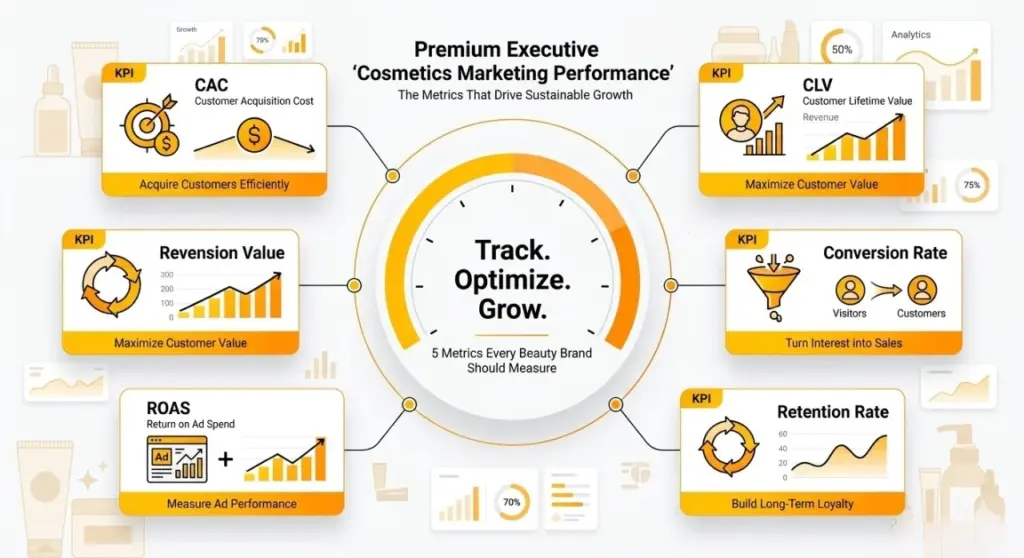
No Cosmetics Marketing Strategy can be considered effective without proper measurement. In the beauty industry, where customer journeys involve multiple touchpoints and longer decision cycles, tracking performance is essential to understand what is working and what needs improvement. Without clear metrics, brands risk investing in channels that do not contribute to real growth.
Customer Acquisition Cost (CAC)
Customer Acquisition Cost (CAC) refers to the total cost of acquiring a new customer, including marketing and sales expenses. It is calculated by dividing total marketing spend by the number of new customers acquired within a specific period.
A lower CAC indicates a more efficient marketing strategy for cosmetic products, while a higher CAC may suggest inefficiencies in targeting, messaging, or channel selection. Beauty brands often aim to balance CAC with long-term customer value to ensure profitability.
Customer Lifetime Value (CLV)
Customer Lifetime Value (CLV) measures the total revenue a business can expect from a single customer over the entire duration of their relationship. It is one of the most important metrics in a skincare marketing strategy because beauty products are often purchased repeatedly.
The formula typically considers average purchase value, purchase frequency, and customer lifespan. A high CLV indicates strong customer loyalty and effective retention strategies. Successful beauty brands focus heavily on increasing CLV through personalization, loyalty programs, and subscription models.
Conversion Rate
Conversion rate represents the percentage of visitors who complete a desired action, such as making a purchase. It is calculated by dividing the number of conversions by total website visitors.
In cosmetics marketing strategy performance analysis, conversion rate helps identify how effectively landing pages, product pages, and checkout processes are working. Even small improvements in conversion rate can significantly impact revenue in e-commerce beauty businesses.
Return on Ad Spend (ROAS)
Return on Ad Spend (ROAS) measures the revenue generated for every unit of money spent on advertising. It is calculated by dividing total revenue from ads by total ad spend.
A high ROAS indicates that paid campaigns are profitable, while a low ROAS suggests that adjustments are needed in targeting, creatives, or campaign structure. In the beauty industry marketing environment, ROAS is especially important because competition in paid advertising is often intense.
Customer Retention Rate
Customer Retention Rate measures the percentage of customers who continue to buy from a brand over time. It reflects how well a brand maintains relationships with its existing customers.
Retention is critical in cosmetics brand marketing because repeat purchases are a major driver of profitability. Strategies such as email marketing, loyalty programs, and personalized offers help increase retention and strengthen long-term revenue stability.
Together, these metrics provide a clear picture of how well a Cosmetics Marketing Strategy is performing and whether it is contributing to sustainable business growth.

Common Cosmetics Marketing Mistakes to Avoid
Even strong beauty brands can struggle when their marketing efforts lack focus. Avoiding these common mistakes can help improve performance and support long-term growth.
- Targeting Everyone Instead of a Specific Audience
Trying to appeal to everyone often results in weak messaging and lower engagement. Clear audience segmentation leads to more effective marketing. - Relying Only on Influencer Marketing
Influencers can increase awareness, but sustainable growth requires a mix of channels, including SEO, content marketing, and paid advertising. - Ignoring SEO
Focusing solely on social media can limit visibility. SEO helps beauty brands attract customers who are actively searching for products and solutions. - Inconsistent Branding
Differences in messaging, design, or tone across channels can reduce trust and make brand recognition more difficult. - Focusing on Vanity Metrics
Metrics such as likes and follower counts are useful, but brands should prioritize business-focused KPIs like CAC, CLV, conversion rate, and ROAS.
Avoiding these mistakes helps create a more effective and scalable Cosmetics Marketing Strategy that supports long-term business growth.
Final Thoughts on Building a Successful Cosmetics Marketing Strategy
Building a successful Cosmetics Marketing Strategy requires more than isolated campaigns or short-term promotional efforts. Beauty brands that grow sustainably are the ones that combine a clear understanding of their audience, strong market analysis, and a well-defined brand positioning with a structured funnel, the right marketing channels, and a strong SEO foundation. When these elements work together, they create a system that consistently attracts, converts, and retains customers.
Throughout this guide, we explored how competitive analysis, customer personas, content strategy, channel selection, and performance measurement all contribute to a strong framework for growth. We also looked at how trends like AI personalization and social commerce are reshaping the future of the beauty industry marketing landscape.
Ultimately, long-term success in the beauty space comes from consistency and integration. Brands that treat marketing as a connected system rather than separate activities are far more likely to achieve stable revenue growth and stronger customer loyalty.
Ready to Build a Cosmetics Marketing Strategy That Drives Results?
Whether you’re launching a new beauty brand or scaling an existing cosmetics business, the right strategy can make the difference between slow growth and real market impact. A well-structured plan helps you attract the right audience, improve conversions, and build long-term loyalty.
At Helio Marketing & Advertising Agency, we help beauty and skincare brands grow through SEO, content marketing, paid advertising, and conversion-focused digital strategies. If you’re ready to strengthen your presence in the competitive beauty market, our team can help you design and execute a performance-driven plan tailored to your goals.
Let’s build a strategy that turns your beauty brand into a recognizable and trusted name in the industry.