

Most podcasts don’t fail because the content is bad. In many cases, they stop growing because they hit a ceiling somewhere between episodes 10 and 20. The hosts keep publishing, the production gets better, and the commitment is still there, but audience growth slows down or stops altogether.
The reason is often surprisingly simple. Many creators assume that producing more episodes will automatically bring in more listeners. That may have been enough when podcasting was less competitive, but today the landscape looks very different.
While recording, editing, and publishing are still essential, they’re only part of the equation. If you want to grow your podcast audience, people need a way to discover your content in the first place. That’s why modern podcast growth depends just as much on distribution, discoverability, and audience engagement as it does on content quality.
It’s also important to understand that not all audience metrics mean the same thing. A download doesn’t automatically create an audience. A listener doesn’t automatically become a subscriber. And a subscriber doesn’t automatically turn into a loyal fan who shares episodes, joins your community, and comes back every week.
Learning how to grow your podcast audience means understanding the entire journey, from discovery and first-time listens to retention and long-term loyalty. The podcasts that consistently grow a podcast audience aren’t always the ones producing the most content. More often, they’re the ones creating the most opportunities for people to find, consume, and share that content across multiple channels.
In this guide, we’ll explore the strategies that actually help grow your podcast audience in today’s crowded market, including content positioning, podcast SEO, discoverability, content repurposing, strategic partnerships, audience retention, and long-term listener growth.

Build a Podcast People Actually Want to Follow
Many podcasters start by asking how to promote their show, or how to grow their podcast audience through marketing tactics alone. But a more important question often gets overlooked: does the show actually give people a reason to come back?
Because in reality, promotion can bring someone to your podcast once, but it can’t make them stay.
If your goal is to grow a podcast audience, the real growth starts when the podcast itself creates momentum. Before focusing on social media, paid promotion, or SEO, it’s worth stepping back and asking whether the listening experience is strong enough to build repeat attention.
The podcasts that grow consistently aren’t just easier to discover, they’re easier to return to.
Define a Clear Niche and Audience
One of the biggest reasons podcasts struggle to grow is that they’re trying to appeal to everyone.
A show about “business” competes with thousands of others. A show focused on content marketing for SaaS startups, personal finance for freelancers, or career growth for first-time managers immediately becomes easier to position.
Specificity helps listeners identify themselves in your content. When someone discovers your podcast, they should instantly know who it’s for and why it matters to them. The clearer that connection becomes, the easier it is to grow your podcast audience over time.
This doesn’t mean your niche has to be tiny. It simply means your positioning should be focused enough that listeners can immediately understand the value you offer.
Create a Consistent Content Format
Many creators think consistency only means publishing on the same day every week.
Scheduling matters, but audience expectations matter even more.
People develop listening habits when they know what they’re returning for. Some podcasts build their audience through interviews. Others rely on case studies, solo episodes, storytelling, debates, or industry analysis.
The exact format matters less than the consistency of the experience.
Think about your favorite podcasts. Chances are they feel familiar even when the topics change. The structure remains recognizable, the pacing feels predictable, and the value proposition stays intact.
That familiarity builds trust, and trust plays a major role in audience growth.
Focus on Listener Value, Not Just Topics
A common mistake among podcasters is confusing interesting topics with valuable content.
An episode might cover a popular subject and still fail to hold attention if listeners walk away without learning something useful, feeling inspired, or gaining a new perspective.
Every episode should answer a simple question:
Why should someone spend the next 30 or 60 minutes listening to this?
The strongest podcasts consistently help listeners solve problems, understand trends, avoid mistakes, or make better decisions.
When listeners repeatedly leave with something valuable, they start viewing the podcast as a trusted resource rather than occasional entertainment.
Improve Audio Quality and Editing
Content may attract listeners, but production quality often determines whether you can actually grow your podcast audience over time.
Most audiences don’t expect studio-level perfection. They’re not listening for cinematic sound design or highly produced audio. What they expect is something much simpler: clear sound, steady pacing, and an experience that doesn’t constantly pull them out of the conversation.
The moment listening becomes distracting, growth becomes harder. Long tangents, inconsistent audio levels, poor microphone quality, or awkward pauses can all quietly reduce retention, even if the content itself is strong.
Good editing isn’t about making a podcast sound overly polished. It’s about removing friction so the listener can stay focused on the value of the episode.
If you’re trying to grow a podcast audience, this part matters more than most creators think. Every unnecessary moment you leave in the episode is a point where someone might drop off.
The podcasts that grow consistently are usually the ones that respect the listener’s time. Every segment has a purpose, and every minute earns its place in the episode.
When that experience is consistent, listeners don’t just finish episodes, they come back, subscribe, and start recommending the show to others.
Make Your Podcast Easier to Discover
Creating a great podcast is only half the challenge.
The other half is making sure people can actually find it.
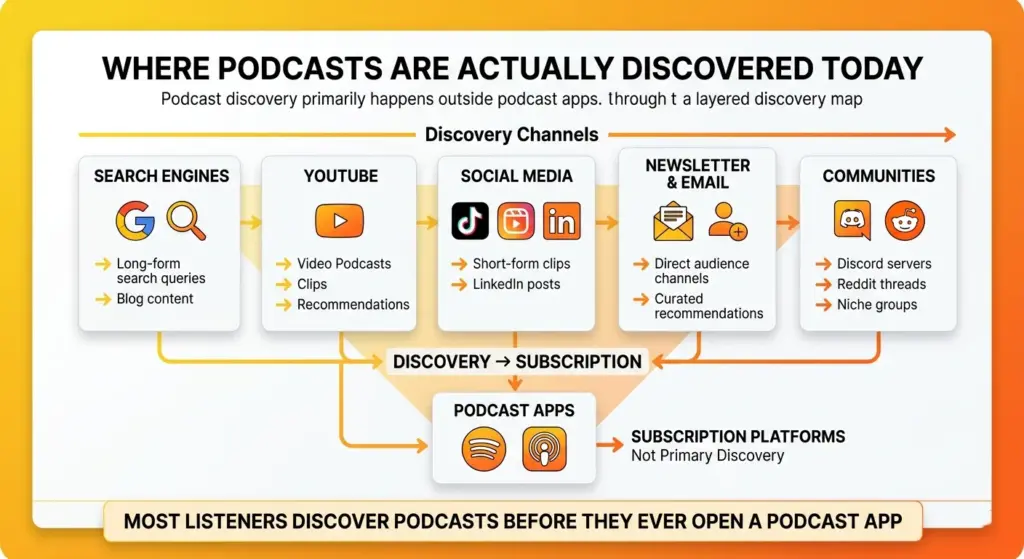
Many creators assume podcast growth happens inside Spotify or Apple Podcasts. While those platforms matter, discovery increasingly happens elsewhere.
People find podcasts through Google searches, YouTube recommendations, LinkedIn posts, newsletters, online communities, and short-form video content. Podcast apps often become the place where people subscribe, not necessarily where they discover a show for the first time.
Optimize Your Podcast Title and Description
Your podcast title is one of the strongest discovery signals available to you. Creative names can work, but clarity usually performs better.
Someone who encounters your show for the first time should immediately understand the topic and audience.
The description should go beyond a simple summary. It should explain who the show serves, what listeners can expect, and why they should subscribe.
Including relevant keywords naturally can also improve discoverability across podcast platforms and search engines.
Use SEO-Friendly Episode Titles
Episode titles often influence whether someone clicks or keeps scrolling.
Compare these examples:
“Episode 42: Growth Talk” versus “How to Grow Your Podcast Audience Without Paid Ads”
The second title clearly communicates value and aligns with search intent.
When creating episode titles, focus on problems people are actively searching for, questions they’re asking, and outcomes they want to achieve.
This approach supports both podcast platform discovery and broader search visibility.
Submit Your Show to Major Podcast Directories
One of the easiest ways to limit audience growth is by restricting distribution.
Listeners use different platforms depending on their habits and devices. Some prefer Spotify. Others rely on Apple Podcasts, YouTube Music, Amazon Music, or smaller podcast apps.
The goal is simple: remove barriers.
If someone wants to listen to your podcast, they shouldn’t have to change platforms to do it.
Optimize for Spotify and Apple Podcasts Search
Spotify and Apple Podcasts both rely on metadata to understand and categorize shows.
Titles, descriptions, categories, artwork, episode naming conventions, and publishing consistency all contribute to discoverability.
While these platforms don’t reveal their algorithms in detail, they reward clear positioning and strong engagement signals.
Podcasts that consistently attract listeners, generate completion rates, and earn subscriptions often gain additional visibility within recommendation systems.
Create a Compelling Podcast Trailer
Most podcast trailers are surprisingly forgettable. Many spend too much time talking about the hosts and not enough time explaining why listeners should care.
A strong trailer quickly answers three questions:
- Who is this podcast for?
- What will listeners gain?
- Why should they subscribe today?
The goal isn’t to tell your entire story. The goal is to create enough curiosity for someone to explore the first episode.

Why Podcast SEO Is Different From Traditional SEO
Many creators assume podcast SEO begins and ends with episode titles. If you’re trying to grow your podcast audience, this is usually the first misconception that holds you back.
In reality, podcast SEO doesn’t live in one place, it operates across multiple channels at the same time.
Unlike traditional SEO, where a webpage competes for rankings inside a single search engine, podcasts can gain visibility through platform search, Google, YouTube, AI-driven search experiences, and even recommendation systems inside podcast apps.
That means podcast discoverability is no longer tied to just one asset. Every piece of supporting content plays a role in how easily people can find you.
Your episode title still matters, but so do your show notes, transcripts, blog posts, video clips, and even your newsletter archive. All of these elements contribute to how search engines and platforms understand your content.
If your goal is to grow a podcast audience, the key shift is this: you’re not optimizing a single episode, you’re building a network of searchable assets around every episode.
The more entry points you create, the higher the chance that new listeners will discover your podcast from completely different places at different times.
Turn Show Notes Into Searchable Content Assets
Show notes are often treated as an afterthought. That’s a mistake!
Detailed show notes help listeners navigate content, provide context for search engines, and create additional opportunities to rank for relevant topics.
Instead of publishing a short summary, consider creating comprehensive show notes that include key insights, resources, timestamps, quotes, and action items.
Over time, these pages can become valuable sources of organic traffic.
Use Transcripts to Capture Long-Tail Search Traffic
Podcast conversations naturally contain hundreds of phrases people search for online. Without transcripts, much of that content remains invisible to search engines.
Transcripts help transform spoken content into searchable text, increasing the chances that your podcast appears for long-tail queries. For creators looking to grow their podcast audience through organic discovery, transcripts can become a powerful long-term asset.
Treat YouTube as a Podcast Discovery Engine
Many podcast creators still view YouTube as a separate channel. Increasingly, it functions as one of the largest podcast discovery platforms available.
Some listeners prefer watching conversations. Others discover podcasts through YouTube recommendations before subscribing elsewhere.
Even simple video versions, audiograms, or static-image uploads can expand reach significantly.
For many shows, YouTube generates more first-time discovery opportunities than traditional podcast platforms.
Turn Every Episode Into Multiple Content Assets
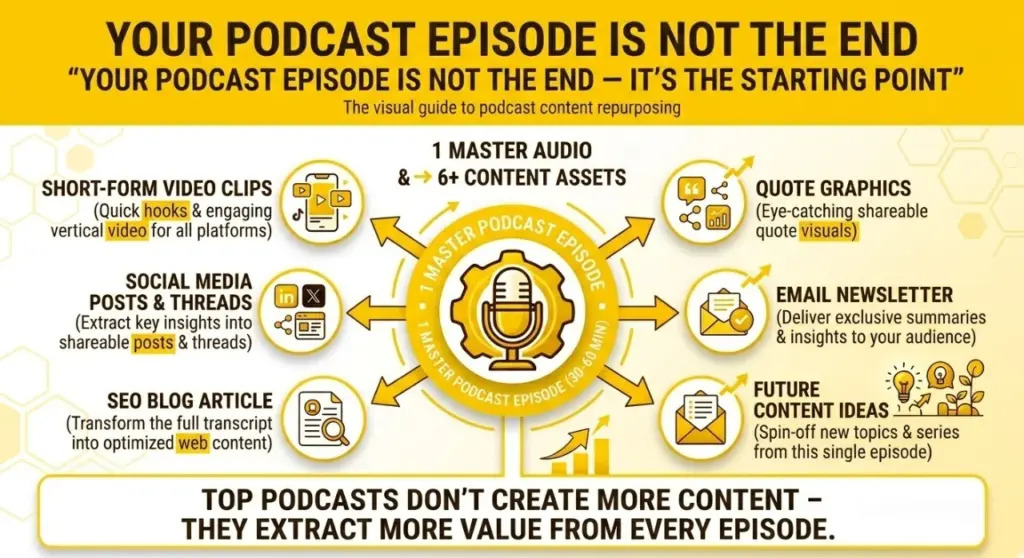
One of the biggest podcast growth mistakes is treating an episode as the final product. The episode should be the starting point.
Modern content creators rarely rely on a single format because audiences consume information differently. Some people listen to podcasts. Others prefer reading articles, watching short videos, or scrolling through social feeds.
Every episode contains multiple opportunities for distribution.
Repurpose Episodes Into Short Video Clips
Short-form video has become one of the fastest ways to grow a podcast audience, especially for shows that rely on discovery outside traditional podcast apps.
A 45-minute conversation might mainly reach people who already follow your show. But a single 30-second clip from that same episode can reach thousands of people who have never heard of your podcast before.
This shift changes how content needs to be designed. The most effective clips are not necessarily the funniest or most entertaining moments. They’re the ones that spark curiosity.
A surprising insight, a strong opinion, a simple but useful framework, or an unexpected statistic tends to perform better because it creates a reason to click through and explore the full episode.
If your goal is to grow a podcast audience, short-form video is no longer optional, it’s part of the discovery system.
In many cases today, podcasts generate more first-time discovery through clips on social platforms than they do through podcast apps themselves.
Create Social Media Content From Each Episode
Publishing a link and writing “new episode available now” rarely produces meaningful results. Instead, extract ideas.
A single episode can generate multiple LinkedIn posts, discussion questions, quote graphics, threads, carousels, and commentary pieces.
The goal is to distribute ideas rather than simply distribute links. People engage with insights first. They click through to podcasts second.
Turn Key Insights Into Blog Posts
One of the most overlooked ways to grow your podcast audience is transforming episodes into long-form written content.
Blog posts allow your ideas to reach people who may never search for podcasts directly. They also create opportunities to rank for relevant keywords and capture organic search traffic.
Instead of summarizing episodes word for word, expand on the strongest concepts and provide additional context, examples, and practical takeaways.
This creates value for readers while introducing them to your podcast ecosystem.
Use Email Newsletters to Promote New Episodes
Algorithms change constantly, Email lists don’t.
An engaged newsletter gives creators a direct communication channel that isn’t dependent on platform updates or recommendation systems.
Rather than simply announcing new episodes, use email to provide extra context, behind-the-scenes observations, curated resources, and exclusive insights.
The goal is to build a relationship that extends beyond the podcast itself.
For many creators, newsletters become one of the most reliable audience-retention channels available.

Grow Faster Through Strategic Partnerships
Many podcasters spend months trying to grow entirely on their own, and if your goal is to grow your podcast audience, this is often where progress slows down.
The challenge is simple: audience growth becomes much slower when every new listener has to discover your show from scratch, without any existing trust or context.
That’s where partnerships change the dynamic. Instead of relying only on your own reach, you can tap into communities that already exist and already trust another creator, host, or brand.
In practice, this means you’re no longer just waiting for people to find your podcast. You’re placing your content inside spaces where the right audience is already active and paying attention.
This is one of the reasons some of the fastest-growing shows don’t necessarily publish more episodes than others. They grow because they consistently borrow attention from relevant audiences through guests, collaborations, and cross-promotion.
If you’re serious about how to grow a podcast audience, partnerships are not a secondary tactic—they’re part of the distribution system.
Invite Relevant Guests
Guest interviews remain one of the most popular podcast growth tactics, but they don’t always work the way creators expect.
Many podcasters assume that inviting bigger guests automatically leads to bigger audience growth. In reality, audience alignment matters more than audience size.
A guest with a highly relevant audience of 20,000 people can often generate better results than a celebrity with millions of followers who have little interest in your topic.
The most successful guest collaborations happen when both audiences benefit.
Before inviting a guest, ask yourself:
- Does this person attract the audience I want to reach?
- Will their expertise create genuine value for listeners?
- Is there enough overlap between our communities?
Guests shouldn’t simply fill episode slots. They should help expand your podcast’s reach while improving the quality of the conversation.
Appear on Other Podcasts
One of the most effective ways to grow your podcast audience is by becoming a guest yourself.
Unlike social media audiences, podcast listeners have already demonstrated that they’re willing to spend time consuming long-form content. That makes them far easier to convert into subscribers.
Appearing on complementary podcasts allows you to build credibility, showcase expertise, and introduce your show to highly relevant listeners.
Some creators spend months chasing social media growth while overlooking one of the most direct audience acquisition channels available.
Cross-Promote With Complementary Shows
Not every podcast is a competitor. In many cases, shows serving similar audiences can help each other grow.
A podcast about content marketing might collaborate with a podcast focused on SEO. A creator podcast might partner with a newsletter about audience growth. Cross-promotion can take many forms:
- Episode recommendations
- Newsletter mentions
- Social media collaborations
- Guest exchanges
- Resource sharing
When executed thoughtfully, both audiences benefit.

Collaborate With Influencers in Your Niche
Influencer partnerships don’t need to be massive to be effective when your goal is to grow your podcast audience.
Many creators make the mistake of only targeting the biggest names in their industry, assuming that reach alone will drive growth. But in practice, smaller voices often deliver stronger results because their communities are more engaged and more trusting.
Micro-creators, in particular, tend to have higher interaction rates and deeper relationships with their audience compared to larger, more general audiences. That trust translates into better conversion when they recommend a podcast.
The most effective partnerships rarely start with a promotion request. They start with connection.
Simple conversations, guest appearances, collaborative episodes, and shared projects build familiarity over time. And that familiarity is what turns into sustainable audience growth, not one-off shoutouts or transactional collaborations.
If you’re looking to grow a podcast audience consistently, these relationship-driven partnerships usually outperform short-term promotional campaigns.
Build a Community Around Your Podcast
Downloads are important, Community is what creates momentum. A podcast can generate thousands of listens every month and still struggle to build long-term loyalty if listeners remain passive consumers.
The strongest podcasts create environments where audiences feel connected, not only to the host, but also to one another.
Encourage Listener Interaction
Many podcast episodes end with generic calls to action asking listeners to subscribe or leave a review. While those actions matter, they rarely create a real connection with your audience.
Instead of ending every episode with the same request, give listeners a reason to engage. Ask a specific question related to the episode. Invite them to share their experiences, opinions, or challenges.
You can encourage responses through social media, email, community groups, or podcast comments.
The goal is to turn listening into a two-way conversation rather than a one-sided broadcast. When people feel heard and involved, they’re far more likely to return, participate, and recommend your podcast to others.
Create a Dedicated Community Space
At some point, relying solely on social media can start to limit your ability to build deeper relationships with listeners. Comments get buried, algorithms change without warning, and conversations often become fragmented across different platforms. That’s why many successful podcasters invest in dedicated community spaces that provide a consistent environment where listeners can connect, interact, and stay engaged beyond the podcast itself.
This could be:
- A Discord community
- A Slack group
- A private forum
- A membership platform
- A private social community
The specific platform matters less than the consistency of engagement. Communities create an additional reason for listeners to remain connected between episodes.

Feature Audience Questions and Feedback
One of the simplest ways to grow your podcast audience is to turn listeners from passive consumers into active participants in the content itself.
Audience questions are especially powerful here because they naturally surface the topics people actually care about, not just what creators assume is relevant. At the same time, they create a subtle sense of ownership over the show.
When someone hears their question being discussed in an episode, the relationship with the podcast changes. It stops feeling like a one-way broadcast and starts feeling more like a conversation they’re part of.
That shift matters. Because when listeners feel included, they don’t just engage more with a single episode, they become more likely to return, follow future episodes, and recommend the show to others.
Over time, this feedback loop improves both content quality and audience loyalty, which directly supports long-term podcast audience growth.
Reward Loyal Listeners
Every podcast has a small group of highly engaged listeners who do far more than simply download episodes. They share your content with friends, recommend the show within their networks, participate in discussions, attend events, and consistently engage with your brand. Identifying and nurturing these listeners is important because they often become your strongest advocates.
Building loyalty doesn’t require a large budget.
Simple initiatives such as offering exclusive content, providing early access to upcoming episodes, sharing behind-the-scenes updates, recognizing active community members, or creating bonus resources can make listeners feel valued and deepen their connection to the show. Over time, these highly engaged fans frequently become one of the most effective and sustainable drivers of podcast growth.
How to Retain Podcast Listeners and Increase Loyalty
Many creators focus heavily on attracting listeners. Fewer focus on keeping them.
Retention is often the difference between slow growth and sustainable growth.
A podcast that retains listeners effectively can grow even with modest discoverability. A podcast with poor retention struggles regardless of how much traffic it receives.
Hook Listeners in the First Few Minutes
Long introductions, excessive housekeeping, and slow openings can cause listeners to leave before they ever reach the most valuable part of your content.
The strongest openings capture attention immediately by creating curiosity and giving listeners a reason to stay.
You can do this by previewing key insights, highlighting valuable takeaways, introducing compelling questions, or sharing a surprising perspective that challenges expectations.
Within the first few minutes, listeners should clearly understand what they will gain from the episode and why it is worth their time.
Use Consistent Publishing Schedules
Consistency plays a major role in building listener habits.
When audiences know exactly when to expect new episodes, your podcast becomes a predictable part of their routine, which helps strengthen loyalty over time.
Whether you publish weekly, biweekly, or monthly is less important than maintaining a schedule your audience can rely on.
Inconsistent publishing often creates unnecessary friction and makes it harder to keep listeners engaged.
Add Clear Calls to Action
Many podcast creators avoid calls to action because they worry about sounding overly promotional.
However, audiences often need clear direction if you want them to take the next step.
Whether your goal is to gain subscribers, grow your newsletter, encourage community participation, or increase episode shares, you need to ask for that action directly.
Well-placed calls to action help move listeners deeper into your content ecosystem and strengthen long-term engagement.
Analyze Listener Drop-Off Points
Downloads only tell part of the story, while retention data often provides much deeper insights into listener behavior.
If audiences consistently leave during the introduction, your opening may need to be more engaging and focused.
If drop-offs occur during specific segments, it may indicate pacing issues, unnecessary tangents, or content that does not match listener expectations.
Audience growth becomes much easier when retention improves because every episode delivers more value to a larger percentage of listeners.
Podcast Growth Metrics That Actually Matter
One of the most common mistakes in podcasting is focusing on metrics that look impressive but provide little insight.
Growth isn’t simply about making numbers bigger. It’s about understanding which numbers actually reflect audience development.
Downloads vs. Unique Listeners
Downloads are useful, but they don’t tell the whole story.
A single listener may download multiple episodes, while another might download an episode and never actually listen to it. Because of this, download numbers alone can create a distorted view of audience growth.
Unique listeners provide a much clearer picture of your actual audience size and reach. When evaluating podcast performance, it’s important to look beyond raw download counts and focus on metrics that reflect genuine listener behavior.
Listener Retention Rate
If there is one metric that deserves more attention, it’s retention.
Many podcasters become fixated on download numbers while overlooking a far more important question: are people actually listening to and finishing their episodes?
A podcast with 500 highly engaged listeners often has significantly greater long-term growth potential than a podcast generating thousands of downloads from listeners who never return. Retention helps you understand whether your content is consistently delivering value and keeping people engaged over time.
Subscriber Growth
Subscribers are one of the strongest indicators of future audience growth.
When someone subscribes to your podcast, they are effectively signaling that they want to hear more from you and are willing to make your content part of their regular listening habits.
Steady subscriber growth is often a sign that your podcast is attracting the right audience and creating enough value to encourage ongoing engagement. As a result, it serves as one of the clearest indicators that your show is building sustainable momentum rather than relying on short-term spikes in attention.
Engagement and Community Signals
Not every meaningful metric can be found inside an analytics dashboard.
Audience replies, community participation, newsletter engagement, social shares, and listener questions all provide valuable insight into how people interact with your content beyond simply downloading an episode.
In many cases, these signals reveal more about audience quality and loyalty than download numbers alone. An engaged community is often a stronger predictor of long-term growth than a large but passive audience.
Setting Realistic Growth Goals
Many podcasters make the mistake of comparing their progress to established shows that have been publishing consistently for years.
However, these comparisons can be misleading because they ignore the time, experimentation, and audience-building efforts that contributed to that success.
Meaningful audience growth rarely happens overnight. More often, it develops gradually through consistent publishing, ongoing refinement, and a deep understanding of listener needs.
Rather than chasing viral moments or dramatic spikes in downloads, focus on making steady improvements across your content, promotion, and audience engagement efforts. In most cases, growing your podcast audience is the result of dozens of small optimizations that compound over time and create sustainable long-term growth.

What NOT to Do When Growing a Podcast
As important as growth strategies are, avoiding common mistakes can be just as valuable.
Many podcasts struggle not because they lack effort, but because they focus on tactics that create short-term activity instead of long-term audience growth.
Chasing Every Trend
Not every trending topic aligns with your audience. Constantly changing direction can weaken your positioning, confuse listeners, and make it harder to build a recognizable brand over time.
Buying Fake Downloads or Subscribers
Artificial metrics may look impressive temporarily, but they don’t create engagement, loyalty, or sustainable growth.
Real audience growth comes from attracting genuine listeners who choose to return to your content.
Publishing Without Promotion
Many podcasts spend hours creating content and only minutes distributing it.
Publishing an episode is only the beginning, and consistent promotion plays a major role in helping new listeners discover your show.
Ignoring Listener Feedback
Listeners often provide valuable insights into what is working, what is not, and where improvements can be made.
Ignoring that feedback means missing opportunities to strengthen both your content and audience experience.
Changing Direction Too Frequently
Making adjustments based on data and feedback is healthy, but constant reinvention can prevent momentum from building.
Give your strategies enough time to produce meaningful results before making major changes.
Grow Your Podcast Audience With a Smarter System
Most podcasts don’t struggle because they lack good content.
They struggle because the content never becomes a system.
They publish episodes, but nothing around those episodes is designed to drive discovery, distribution, or long-term audience growth.
If there’s one idea to take away from everything in this article, it’s this:
Growing your podcast audience is not about publishing more episodes. It’s about turning every episode into multiple opportunities for people to find you.
That means:
Growing a podcast audience requires more than publishing episodes. It means designing content with distribution in mind, treating every episode as a source of clips, posts, and search traffic, building discovery beyond podcast platforms, and creating repeatable systems instead of relying on one-off promotion efforts.
This is exactly where most creators hit a ceiling. Not because they stop creating, but because their content stops moving beyond the original upload.
That’s also where a structured content system makes the difference.
Tools and workflows like Helio are built around this shift. Instead of thinking about podcasting as “episode creation,” they help teams think in terms of content engines, where each episode is processed, repurposed, and distributed across multiple channels with intention.
Not as extra work, But as part of the same system.
Because in today’s landscape, podcasts don’t grow just by being published. They grow when every episode keeps working after it goes live.